The Importance of Visualizing Work in Kanban
In the Visualizing work in Kanban is more than a practice. It is the foundation for improving flow, increasing transparency, and strengthening delivery predictability. When teams make their workflow visible, they expose bottlenecks, clarify priorities, and create the conditions for continuous improvement. Without clear visualization, work remains hidden, coordination suffers, and performance becomes difficult to improve.
A helpful definition of Kanban is: “A management method designed to enhance service delivery by making invisible knowledge work visible as it progresses through a workflow.” Let’s break down four key concepts in this definition:
Management method: Kanban is a tool for managing work, not a project management methodology. It focuses on visualizing the flow of work as it moves through a process.
Service delivery: Teams form to deliver something of value. This delivery process can be seen as a series of activities that provide value to the customer or end user.
Knowledge work: Knowledge work, such as analysis or design, is intellectual labor that results in unique outputs. It’s often invisible because it resides in the minds of those doing the work.
Workflow: A workflow is the movement of value through a system.
Have you ever wondered why agile teams create scrum boards, story boards, or kanban boards to track work? These boards serve two important purposes: 1) identify and make explicit the team’s workflow to get work finished, and, 2) make visible the knowledge work (many times in the form of user stories), the that move across this workflow.
Let’s dig into both concepts a little more.
Workflow
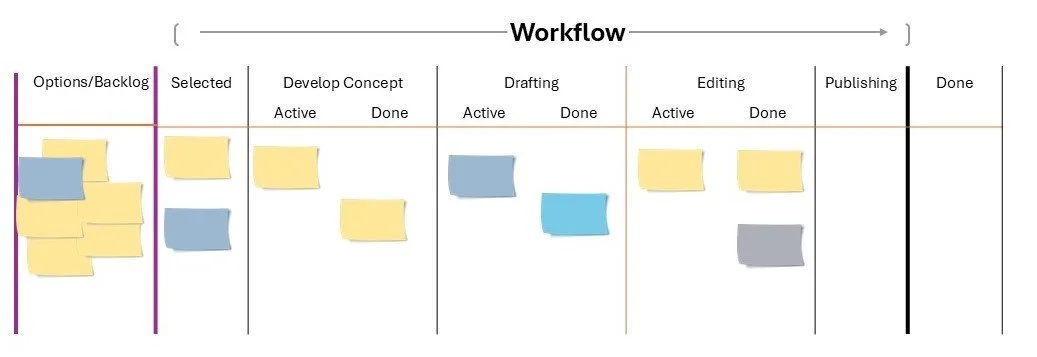
I identified earlier that workflow is the movement of value through a system. Teams identifying their workflow consider the unique stages, or steps, they go through to deliver value. At its simplest, a workflow consists of three stages: To Do, Doing, and Done. “To Do” lists work that hasn’t started, “Doing” represents activities to complete the work, and “Done” signals completion.
Teams looking to enhance their workflow might expand the “Doing” stage, creating columns that represent key activities in completing the work (see image below). These columns don’t indicate handoffs or tasks assigned to specific roles, but rather phases in the work’s progression reflecting the flow of knowledge and value creation. When realizing this, the team’s focus now becomes how work moves through the system rather than who performs each task. Teams can now consider the coordination and collaboration needed to get the work done allowing them to identify inefficiencies—such as bottlenecks—and make adjustments to optimize flow and predictably deliver value.
Source: Kanban University
Making the Invisible Visible
Because knowledge work resides mostly in our minds, it remains largely invisible. A practical way to make the invisible visible is by creating something that explicitly represents it. This is why teams use cards that move across the workflow on a Scrum or Kanban board. In essence, these cards serve as a physical representation of the team’s invisible inventory of work. By visualizing the work in this way, we gain insight into what team members are currently working on, where bottlenecks may be forming, and the work that can be addressed next.
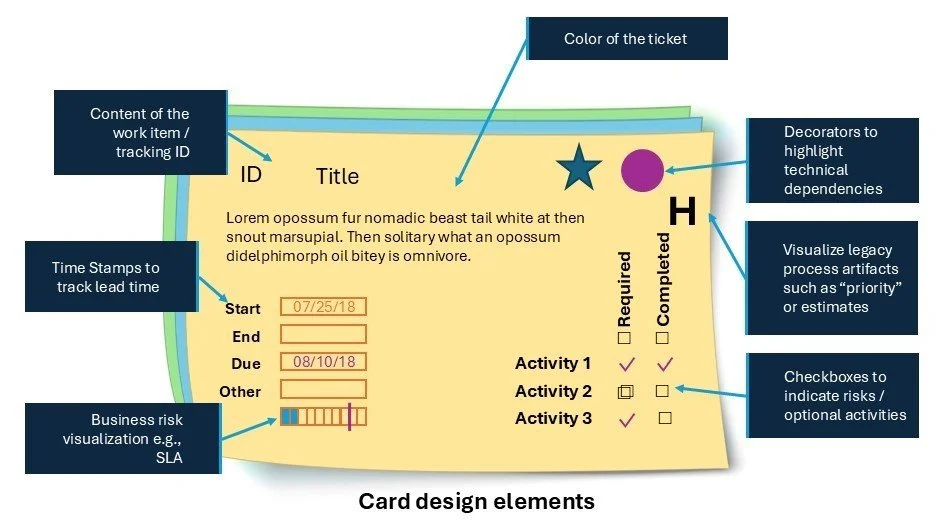
Effective card design (see image below) is key to a successful Kanban system. A well-designed card should display relevant information to aid decision-making. Some elements to consider for card design include:
Work item description
Time stamps (Start, End, Due dates)
Time spent in each process stage
Visual indicators to highlight risks, priorities, or dependencies
Colors to represent work item types, classes of service, or other categories
(note: some online tools may have limitations in supporting all of these features)
Source: Kanban University
Conclusion
Visualization, from mapping workflow stages to creating clear card designs, is crucial to Kanban’s effectiveness. While there are many aspects to visualization, focusing on these foundational practices will set the stage for more advanced improvements. In the next article, we’ll explore how to manage the amount of work a team takes on by using Work in Progress (WIP) Limits.
Return to My Articles