Kanban Cadences
At the heart of Kanban is a commitment to continuous learning and adaptation, and it’s through structured feedback loops that teams gain the insights needed to evolve their processes and improve outcomes. The Kanban Maturity Model Second Edition describes feedback loops as “the general practice to enable reflection against desired outcomes and enable the opportunity for adjustments, changes, and mutations to policies processes workflows and working practices.”
When implemented well, these loops create a system that helps organizations learn from the work they’re doing as they do it. Each has its own purpose, frequency, and scope. Together, they form an interconnected web of learning opportunities that operate at different levels of the organization.
Two Sets of Feedback Loops
Kanban defines two sets of feedback loops: one set focuses on managing and improving the work of a single service. The other set focuses on improving the performance of a network of services by refining the policies for managing the interdependencies among the individual services.[1] The periodic meetings and reviews are collectively known as the Kanban Cadences.
Let’s take a brief look at the types of meetings and reviews suggested.
Feedback loops for improving a single service:
Feedback loops for improving a single service:
Kanban Meeting (Daily): Teams review the current state of work, address blockers, surface process issues, and agree on next steps.
Replenishment Meeting (Weekly): Teams decide which work to pull from the backlog based on current capacity and demand.
Delivery Planning Meeting (Per Delivery Cadence): Prepares the team and customer for upcoming deliveries by coordinating expectations and timelines.
Service Delivery Review (Bi-weekly): Teams reflect on recent performance, analyze flow metrics, and identify ways to improve service delivery.
Feedback loops for improving a network of services:
Operations Review (Monthly): Leaders and service owners examine the performance and interactions across multiple services to uncover systemic issues and improvement opportunities.
Risk Review (Bi-weekly or Monthly): Cross-functional stakeholders assess risks across products and services, aligning mitigation efforts with business and stakeholder expectations.
Strategy Review (Quarterly): Market leaders evaluate market trends, review go-to-market strategies, and adjust based on key performance indicators.
Note that meetings are focused on managing the work conducted and ensuring outcomes meet customers’ expectations. Reviews are opportunities to assess the performance of the system (and their interdependencies with other systems) and identify opportunities for improvement.
Remember: Start with What You Do Now
It’s important to remember that Kanban encourages teams to start with their current process. You don’t need to implement every feedback loop from day one. Most teams already have meetings that serve some of these purposes—they just aren’t always focused on flow, delivery, or learning.
Rather than introducing a new set of ceremonies, consider how your existing meetings can be repurposed to serve the intent of these cadences. For example, your current weekly team sync might evolve into a Replenishment Meeting, or your monthly business review might incorporate elements of a Service Delivery or Risk Review. The goal is to make feedback loops intentional, not burdensome.
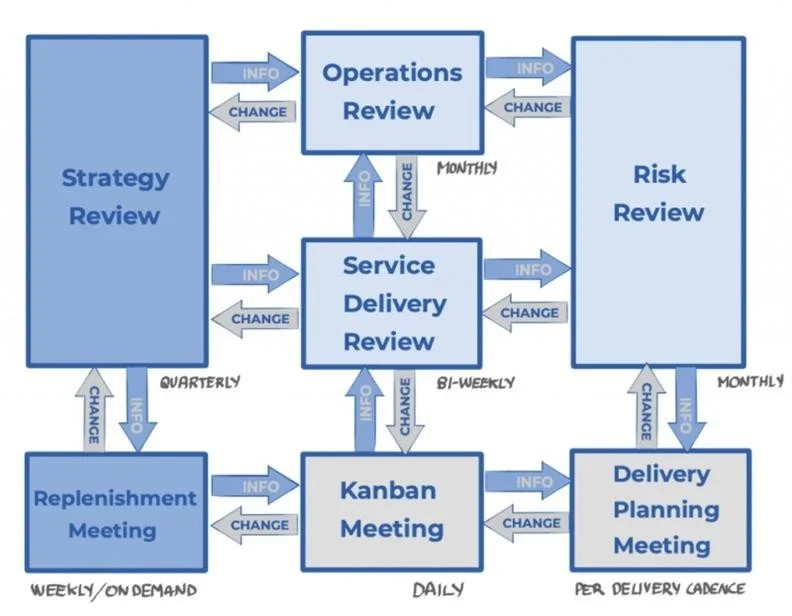
Kanban Feedback Loops and Cadences
Making Sense of the Arrows: “Info” vs. “Change”
In the diagram above, you’ll notice two kinds of arrows between the meetings/reviews—Info and Change. These are essential to understanding how feedback moves through the system.
Info arrows represent the flow of insights, metrics, and observations. These help inform other meetings and reinforce understanding across different levels of the organization. For example, a daily Kanban meeting might surface issues that later inform discussion during a Service Delivery Review.
Change arrows indicate where a meeting/review might trigger a policy, prioritization, or process adjustment in another part of the system. A Risk Review, for example, could lead to changes in how work is selected during the next Replenishment Meeting.
Building a Culture of Feedback
Successfully implementing feedback loops is not just about holding the right meetings. It’s about creating a culture where feedback is welcomed and used constructively. Team members need to feel safe speaking openly about challenges and opportunities. Feedback discussions should center on the health of the system—not individual performance. And most importantly, feedback must be treated as input for improvement, not as critique.
[1] Kanban Maturity Model Second Edition, 2020